|
|||||||||||||||||
|
|
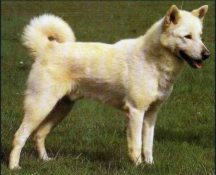
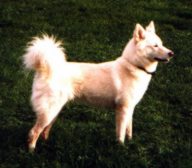
Coat: Outer coat dense, harsh and straight, of short to medium length, undercoat close and profuse. The correct Canaan coat is of great importance. The coat provides protection from the extremes of the climate, which can range from extremely hot to extremely cold, even, at some times of the year, within the same twenty four hour period. People have a tendency to imagine that the Middle East is a desert, with a burning sun shining down on unlimited sand. This is not at all accurate. Israel is a harsh and extremely arid region (though close to the coast the climate can be quite humid), and there is a great range of temperatures. In the day the temperature can be over 40 degrees C at some times of the year, and at night it can be below freezing. There are times of the year with sudden and heavy rains, and in some areas, even snow. The Canaan’s coat has to protect him from all of these extremes of climate, as well as protecting him from the prickly vegetation and thorn bushes so prevalent in the area, from parasites such as fleas and ticks, and from the attacks of other dogs or animals. Therefore, the Canaan has a double coat, the type of coat found in most of the wild and semi-wild canines. This coat is also typical of many of the other Spitz breeds. The outer coat is of rather harsh and very strong hair of medium length, that stands out a bit from the body. This characteristic helps it to serve to catch thorns and stickers before they penetrate to the skin, to shed rain and damp, and to provide some aeration to the skin for cooling during the hot days. A very short coat will not provide these functions. The undercoat, which is extremely thick and wooly, provides insulation from the cold, the heat, and the rain, and little can penetrate it, including parasites, thorns, or the teeth of other animals. This undercoat is shed twice a year and then quickly grows back. Lack of undercoat is a very serious fault – this is a characteristic that is definitely anti-survival. It should be noted that the breeds of dog that suffer the most from the heat and the sun in hot climates are those with very short coats and no undercoats (Boxer, pinscher), and not dogs with heavy and thick coats. One sometimes sees Canaans, even with the Bedouin, with a longer coat, somewhat similar to that of a Belgian Sheepdog in length. Although the coat may be of good harsh texture, this length of coat is undesirable. Longer coats than this also sometimes occur, and they are usually very soft or silky in texture – these coats are highly undesirable, as their texture provides the dog with very poor protection. Feathering
on the buttocks, the ruff on the neck, and the plume on the tail
are usually a bit longer than the rest of the coat, but should
not be too long or of a soft texture.
|
||||||||||||||||