|
|||||||||||||||||||||
|
|
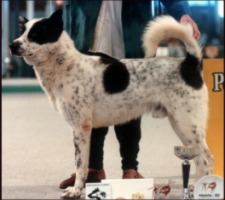
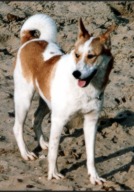
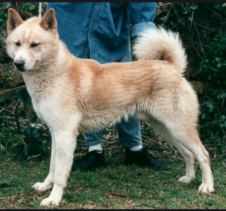
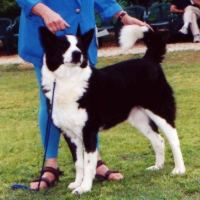
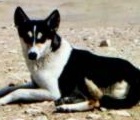
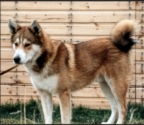
Color: Sand to red brown, white, black or spotted, with or without mask. If masked, mask must be symmetrical. Black mask permitted on all colors. White markings are permitted on all colors. Boston Terrier patterns are common. Grey, brindle, black and tan or tricolor are unacceptable. Desert colors – sand, gold, red, cream – are most typical of the breed.
There is a very wide range of acceptable colors and patterns in the Canaan. Some colors seem to be more typical of certain parts of the country from which those dogs originated – black and black and white are more typical to the rocky an forested north, while the pale sand colors, creams, golds, and reds are more typical to the southern wilderness and desert areas. As a wide range of colors is accepted, it is easier to list those that are not acceptable. The colors that are most definitely not typical to the Canaan are brindle (as in a boxer, for example) and liver. These are colors that we have never seen among wild born populations and have not had in pure bred litters born in Israel. These would be considered as indications of possible mixed ancestry should they occur. Liver presents another problem as well, as the liver color is connected with self colored nose and eye rims and yellow eyes – anti survival factors for a dog spending a great deal of time exposed to the brutal middle eastern sun. Black and tan (as in a Doberman, for example) and tricolor (as in a beagle – large clear patches of brown, black and white, or more commonly, black saddle fading into tan sides, legs, neck, as in a German Shepherd, with additional white trim) do occur in the Canaan. These are recessive characteristics that sometimes appear, but this color is undesirable. Prof. Menzel felt that these colors were not typical or distinctive and that they gave the Canaan a “mixed breed” appearance. Dogs of these colors are not acceptable for show, and preferably should not be bred from, as they will pass the color on. What appears to be gray, or gray patches, may also occur in the Canaan, but this is usually the result of mixed black and white hairs giving a gray impression. True gray, as in a Weimaraner, is a totally unacceptable color. A Canaan with a correct basic color of the cream to red shades may sometimes have a black overlay. This is usually very obvious in young puppies, and disappears with time as they mature and grow their adult coats. At times, however, some black overlay remains, leaving the color looking “muddy”. This is not considered tricolor, but is not desirable. The Canaan may have a mask, either black or white, on any color. The mask is not essential, but if there is a mask, it should be symmetrical. An asymmetrical mask can be most unattractive and interfere with the correct expression. Various color patterns
are common – solid with white trim (feet, chest, white on
neck and tail, blaze); Boston Terrier patterns are not uncommon
and are quite attractive. Spotted dogs can have anything from
minimum spots to large spots covering a good deal of the body,
or a good deal of ticking over the whole body. All of these patterns
are completely acceptable. Undesirable colours...
|
||||||||||||||||||||